By: Chieloka Anadu
According to Elijah Grannis, the world of art is not just about what you can see, but what you can unlock. While many artists work with the tactile resistance of clay or the flat surface of a canvas, Elijah works with a medium that is as temperamental as it is transformative: resin.
Elijah’s practice is a high-stakes dialogue between his imagination and a material that, in his words, is “unforgiving.” The result is a body of work that captures movement and light in a way that feels suspended in time.
Every artist has a “moment of ignition,” and for Elijah, it happened in an art gallery half a world away in New Zealand. There, he encountered a single piece – a shell filled with resin, encasing a miniature underwater world of seaweed, rocks, and life.
“I thought it was one of the coolest things I’d ever seen,” he recalls. That encounter did more than just inspire a new hobby; it unlocked a hidden chamber of his mind. Upon returning home, his first pour wasn’t just an experiment, it was the start of a mission to do things with resin that no one had ever attempted before.
In a medium where many artists fall into similar patterns, Elijah is a pioneer. He deliberately avoids the traditional “resin art” tropes, choosing instead to forge an aesthetic that is entirely his own.
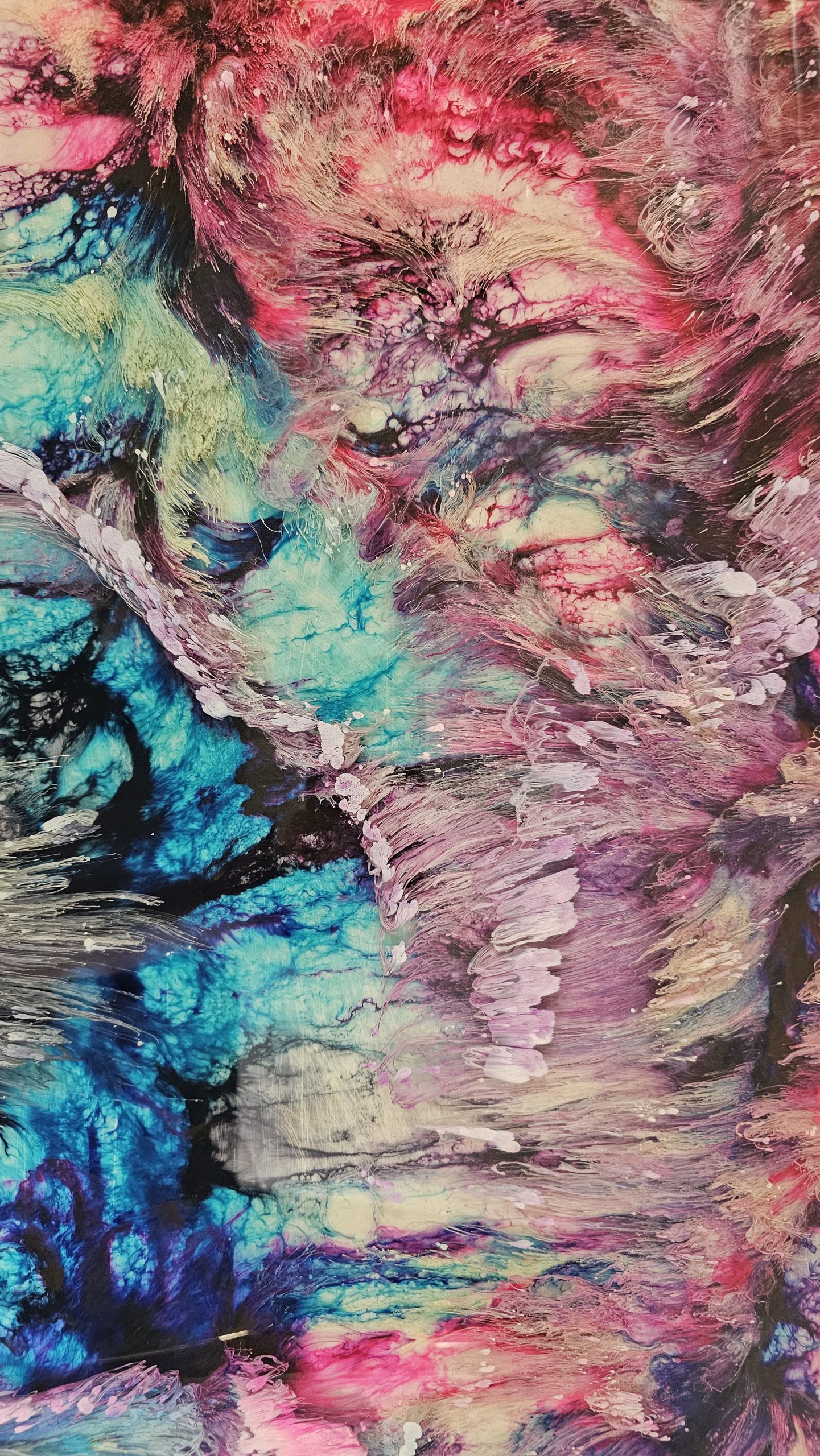
He works primarily with resin, alcohol inks, and pigment powders. By combining these, he creates patterns that are impossible to replicate – unique topographical maps of colour and depth. Interestingly, many of his techniques are so experimental that they don’t yet have names. They are simply the physical manifestations of his internal visions, born from a desire to stand out in a field that is still defining its own boundaries.
For Elijah, the challenge isn’t finding inspiration, it’s the engineering of his own imagination. He describes a mind overflowing with visions, where the real battle is the “how.”
Working with resin is a lesson in resilience. “I’ve made every mistake you can make,” Elijah admits. There were moments of deep discouragement when a technique failed or a vision seemed physically impossible to achieve. Yet, it is through this “trial and tribulation” that he has honed his skill. Each mistake was a lesson, turning his process into a refined alchemy that allows him to manifest complex visions with a sense of ease that belies the difficulty of the craft.
If Elijah’s work could speak, it wouldn’t offer a long-winded explanation of its origins. Instead, it would acknowledge the immediate impact it has on the viewer. It would say: “From the look on your face, I can tell you’ve never seen anything like me.”
This sense of wonder is the heart of his practice. He aims to stop the viewer in their tracks, presenting them with something so alien and yet so beautiful that it challenges their understanding of what “art” can be.
Participating in the Blossom exhibition is more than just a professional milestone for Elijah; it is the fulfillment of a lifelong dream. To have his work travel from his studio to an international stage at Anadu Art Gallery in London represents a significant “emergence” in his own career.
Professionally, it is a powerful addition to his portfolio. Personally, it is a “mind-blowing” validation of the years spent fighting with sticky surfaces and failed pours. For Elijah Grannis, Blossom is the moment his visions finally take their place on the world stage, proving that when you take the imagination to its limits, the results are truly world-class.
Follow Elijah’s journey on Instagram: @elijahgrannis
Leave a Reply